
Survey Swapping vs. Survey Panels: Which Is Right for Your Research?
25 views
Share this article:
You need 300 survey responses. Fast.
Two options sit in front of you. Pay $900-1500 to a panel service. Or spend 25-50 hours taking other people's surveys in exchange for them taking yours.
Neither sounds ideal. But one might be right for your situation.
What Survey Panels Actually Are
Survey panels are databases of people who've signed up to take surveys for money. Companies like YouGov, Prolific, and dozens of smaller firms recruit these people, verify their demographics (supposedly), and rent them out to researchers.
You tell the panel company what kind of people you need. "500 US adults aged 25-40 who use streaming services." They find those people in their database. Send out your survey. Charge you $3-5 per completed response.
Simple. Expensive. And increasingly problematic.
The Hidden Problems With Survey Panels
Panel quality used to be pretty good. Not anymore.
A 2020 study by Grey Matter Research tested five of the ten largest panel providers. They had to throw out 46% of respondents for serious quality issues. Not small mistakes. Egregious problems like gibberish answers, impossible completion speeds, or multiple red flags in a ten-minute survey.
46%. Nearly half the data was garbage.
Kantar found researchers discard an average of 38% of panel data due to quality concerns. Some studies report discarding up to 70%. When you're paying $3-5 per response and throwing out half of them, your actual cost per usable response doubles.
The fraud problem is real and getting worse. Bots pose as respondents. Click farms in other countries pretend to be US consumers using VPNs. Real people rush through surveys without reading questions because they're paid on completion, not quality. The incentive structure is broken.
Professional panelists learn to game screeners. They know if they say yes to certain questions, they'll qualify and get paid. So they lie. A study found 58% of fraudulent respondents claimed brand awareness of Charity Navigator (a real but relatively unknown organization) compared to 15% of legitimate respondents. Why? They thought claiming awareness would help them qualify.
Gallup ran tests on six major panel providers in 2023. Two panels consistently produced terrible data regardless of how they measured quality. The problem? You don't know which panels are which. Most providers don't reveal their quality metrics. They just send you data and invoice you.
Panel conditioning is another issue. People who take surveys professionally change their behavior. According to Pew Research, repeated panel participation makes people more politically engaged, more likely to follow news, and more aware of public figures than the general population. Your "representative sample" isn't representative anymore. These are professional survey takers, not normal people.
Then there's the attention span problem. SurveyMonkey found that in surveys longer than 30 questions, respondents spend half as much time per question compared to shorter surveys. They're not reading carefully. They're skimming and clicking the first acceptable answer. Quality dies around question 10 because people are bored and want to finish.
Demographic profiles go stale. Someone joins a panel as an IT manager at a mid-size company. Three years later, they're a director at an enterprise. But the panel database still lists them with outdated information. You think you're surveying mid-market IT managers. You're actually getting enterprise directors.
What You Actually Pay For Panels
Let's talk real numbers. The ones panel companies don't advertise clearly.
Basic consumer panels charge $2-3 per completed response for general population surveys. Need 500 responses? That's $1000-1500 baseline.
Niche audiences cost way more. IT professionals earning six figures? Business decision-makers? Doctors? Expect $5-10 per response. That same 500-person survey now costs $2500-5000.
But wait. There are hidden costs nobody mentions upfront.
Screening costs money. If only 20% of people qualify for your survey (low incidence rate), you pay for everyone who gets screened out. Panel companies call these "terminates" and you're billed for them. Your effective cost per completed response can triple. That $3 response becomes $9 after screening.
Setup fees exist at many providers. Project minimums of $2000-3000 are common. Small surveys under 100 responses often get hit with these even if your actual per-response cost would only be $300. The panel companies don't want small projects. They price them out.
Data cleaning is on you. That 46% of bad responses? You're paying for them. All of them. Then paying someone (or spending your time) to identify and remove them. Your panel provider won't refund you for bot responses or speeders.

Translation costs if you need multiple languages. Expect $500-1500 per language. Integration fees if you want the panel company to work with your survey platform. Premium support costs extra. Rush fees if you need data fast.
Some panels use subcontractors without telling you. They can't fulfill your order from their own database so they farm it out to three other panels. You have no idea who actually provided your data. Quality becomes impossible to verify.
A "simple" 500-response survey can easily hit $2000-3000 after everything. The initial quote said $1500. Somehow the final invoice is double.
What Survey Swapping Actually Is
Survey swapping flips the model. Instead of paying money, you pay time.
You need 200 responses. You agree to take 200 surveys from other researchers. Fair trade. Everyone gets what they need. Nobody pays money.
The coordination used to be a nightmare. Finding researchers, matching survey lengths, tracking who owes what, dealing with people who took your survey but never reciprocated. That's why platforms emerged to handle the logistics automatically.
Here's how it works on a swap platform. You upload your survey link. Specify how many responses you need and basic details about survey length. The platform matches you with other researchers who need similar numbers. You take their surveys. They take yours. The platform tracks everything and keeps it fair. Nobody can game the system.
Academic researchers have done informal swapping for years. Graduate students post in research forums: "I'll take your 10-minute survey if you take mine." It works because both parties understand the value of data and both have the same problem. Limited budget, tight deadlines, thesis committees demanding statistical significance.
The beauty of the system is aligned incentives. Everyone participating is a real researcher who needs quality data for their own work. They have skin in the game. They give thoughtful answers because they want thoughtful answers back. It's reciprocity in action.
Panel respondents are doing it for $2. They're optimizing for volume. Take 20 surveys in an hour, make $40. Speed through, click answers without reading, move on to the next one. Their incentive is quantity.
Swap participants are doing it to get their own research done. They care about survey quality because poor quality data ruins research. Different motivation. Different outcome. Better data.
The community aspect matters too. When you know other real researchers will see your survey, you design it better. You keep it short. You write clear questions. You respect their time because they're respecting yours.
The Real Costs of Survey Swapping
Survey swapping isn't free. It costs time. But probably way less than you think.
Most surveys on swap platforms are short. Really short. We're talking 1-2 minutes on average, not the 10-15 minute monsters you might imagine.
Why so brief? Because everyone in the system is also a researcher who needs responses. Nobody wants to take a 20-minute survey. So nobody creates them. The community naturally keeps surveys concise. It's self-regulating.
Here's the actual math. Need 200 responses? At 1-2 minutes per survey, you're looking at 200-400 minutes total. That's 3.3 to 6.6 hours.
Spread over two weeks, that's less than 30 minutes per day. Spread over a month, it's about 10-15 minutes per day. You probably spend more time scrolling social media during your coffee break.
Compare that to panel costs. Those same 200 responses cost $400-1000. How many hours would you need to work to earn $400-1000 after taxes? For most people, that's 8-20 hours of actual work. Suddenly 3-6 hours of survey taking doesn't sound so bad.
The ROI is clear. Six hours of your time versus $600 out of pocket. That's $100 per hour saved. Show me another research method with that kind of return.
Some platforms let you speed things up by having multiple people on your team participate. Need 500 responses but only want to spend 2 hours personally? Get five people to each take 100 quick surveys. The work gets distributed. Everyone chips in 1-2 hours. Done.
The time investment is predictable. You know exactly how many surveys you need to take. You can do them while waiting for meetings. During lunch. On your commute (if you're not driving). In small chunks throughout your day. No budget approval needed. No procurement process. Just time you control.
When Panels Make Sense
Panels work when you have money but no time.
Tight deadline? Need data by Friday? Panels can field a survey in 24-48 hours if you pay rush fees. Survey swapping takes longer because you're dependent on other researchers completing your survey.
Very niche audiences sometimes require panels. Surveying CEOs of Fortune 500 companies? Physicians specializing in rare diseases? B2B decision-makers with specific titles at specific company sizes? Panels have established relationships with these hard-to-reach groups.

Large sample sizes favor panels if you can't get enough team participation for swapping. Need 2000 responses? That's 2000 surveys to take. Even with a team, that's a lot. Panels handle that volume easily.
High budget research projects where data quality can be verified and cleaned. If you're a large company with data analysts who can identify and remove bad responses, panel costs are just a line item in a bigger budget.
Market research firms doing client work. When you're billing clients, panel costs get passed through. Time spent taking surveys doesn't.
When Survey Swapping Makes Sense
Swapping works when you have time but limited budget.
Academic research is the classic use case. Grad students, researchers, professors working on studies without big grants. You have time. You don't have $3000 for panel responses.
Small businesses doing customer research. Startups validating ideas. Nonprofits gathering community feedback. Budget-constrained but time-rich. Start your free survey today.
Iterative research where you need multiple rounds of feedback. Testing and refining surveys before a big launch. Swapping lets you do pilot studies without burning budget.
When you care more about response quality than speed. Swap participants are typically more engaged. They understand surveys. They give better answers.
Surveys targeting other researchers, students, or professionals who are already in swap networks. Your target audience is in the system.
When you have a team willing to share the workload. Five people each taking 100 surveys is less painful than one person taking 500.
The Quality Question
This matters more than cost or time.
Panel quality varies wildly. Some providers are solid. Others are terrible. You often don't know until you've paid and cleaned your data. Even the good ones struggle with the 30-40% fraud and low-effort response problem documented across the industry.
Swap quality tends to be more consistent because participants have intrinsic motivation. They're not professional survey-takers gaming the system for beer money. They're researchers who understand what good data looks like. They need quality responses to their own surveys, so they give quality responses to yours.
The reciprocity creates accountability. Take someone's survey seriously, they take yours seriously. Rush through carelessly, and the system flags you. The community self-regulates because everyone has the same stake.
With panels, you implement quality checks after the fact. Attention checks, consistency questions, reviewing for impossible completion speeds. You catch bad responses and throw them out. But you already paid for them. Your $3 per response becomes $5-6 per usable response after cleaning.
With swapping, poor quality is less common upfront. Platforms track completion rates and response quality. Users who give bad data get flagged or removed. The barrier to entry (being an actual researcher with a real survey) filters out the bots and click farms automatically.
Here's the bottom line math. Panels give you speed but cost $400-1000 for 200 responses, and 30-40% might be unusable. Survey swapping costs 3-6 hours of your time for the same 200 responses, with higher average quality. Three hours to save $500-800. That's a $150-250 per hour return.
The Real Comparison
Let's be honest about what each approach actually means.
Panels give you speed and convenience. You define your audience. Upload your survey. Wait. Download data. The process is smooth if you have the budget.
The tradeoff is cost and quality risk. You're betting that the panel you chose is one of the good ones. You're accepting that 30-50% of your data might need cleaning. You're paying premium prices for responses that may or may not be legitimate.
Swapping gives you cost savings and often better quality. You're getting responses from engaged participants who care about research quality.
The tradeoff is time and speed. You're taking surveys yourself (or your team is). You're waiting for other researchers to complete your survey. The process takes longer.
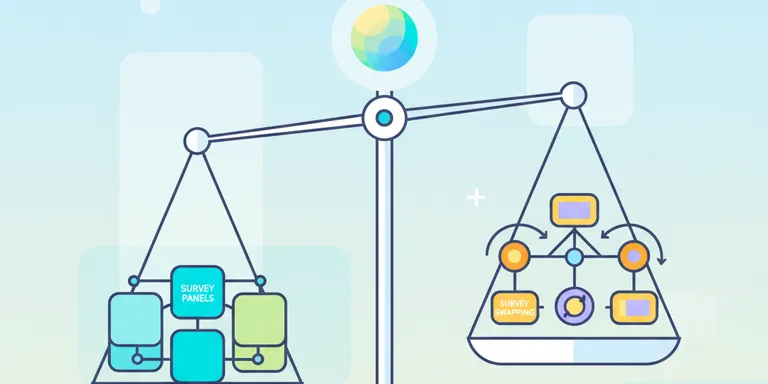
Neither is perfect. Both have their place.
Ready to Try Survey Swapping?
If this comparison has convinced you that survey swapping might be right for your research, get started with SWapp today. Create your survey, set your response goal, and join a community of researchers committed to quality data collection.
What SWapp Does Differently
Full disclosure: SWapp is a survey swapping platform. We built it because we saw the panel problems and knew there had to be a better way.
The platform handles all the coordination. Upload your survey. Specify how many responses you need. Start taking surveys from other researchers. As you complete surveys, your survey gets distributed to others.
The matching is automatic. The tracking is automatic. You don't chase people or manage spreadsheets. The platform does that.
Fair trade is enforced. If you want 200 responses, you take 200 surveys. Nobody games the system. Everyone contributes equally.
The community is real researchers. Students, academics, market researchers, business analysts. People who understand survey methodology and care about data quality.
Making the Choice
Here's a simple decision framework.
Choose panels if:
- You have budget over $2000
- You need results in 48 hours
- You're surveying very niche B2B audiences
- You have data analysts to clean responses
- Time is more valuable than money for your team
Choose survey swapping if:
- Budget is under $1000
- You have 2-4 weeks for data collection
- Your team has time to participate
- You want higher quality, engaged responses
- You're doing academic or early-stage research
Choose both if you have the resources. Use swapping for pilot studies and survey testing. Use panels for your final large-scale data collection. This combination gives you the best of both approaches.
The Bigger Picture
The survey research industry is changing. Panel quality problems are well-documented and getting worse. Researchers are looking for alternatives.
Survey swapping isn't new. The concept has existed informally for decades. What's new is the infrastructure to make it scalable and efficient.
Platforms like SWapp make swapping practical for more researchers. The coordination problem is solved. The fairness problem is solved. What remains is the time investment, which is the actual tradeoff.
For many researchers, that tradeoff makes sense. Time they have. Budget they don't.
For others, panels remain the right choice despite the flaws. Speed and convenience matter more than cost.
The key is understanding what you're actually getting with each approach. Not what marketing claims. Not what you hope for. What you actually get.
Panels give you speed and scale with questionable quality and high costs. Swapping gives you better quality and no costs with time investment and slower turnaround.
Pick the model that fits your constraints. Both work. Neither is perfect. Choose based on what matters most for your specific research.
Sources:
Share this article:

_1.webp)